An enterprise brain is the governed system that gives people and software access to an organisation’s knowledge. It remembers what the organisation knows, assembles evidence for a request, supports reasoning and lets authorised work proceed.
The difficult part is deciding what the system may treat as true. A fluent answer can mix approved knowledge with stale operational data or unsupported inference. It can also add a plausible invention. Retrieval alone cannot police those boundaries.
The architecture therefore starts with a deterministic spine. In this context, deterministic means that explicit rules and persisted decisions control truth admission, access, release and effects. The model may extract candidate claims and narrate evidence, while any judgement it makes remains bounded by the spine. It never decides truth.
Four controls make that boundary concrete. Live federation queries an operational authority in place, while a declared operational projection remains rebuildable and serves only within its freshness controls. Before an answer leaves, the governed release gate checks permission. Durable effect settlement records intent before an external action and the outcome afterwards, allowing interrupted work to recover from recorded state.
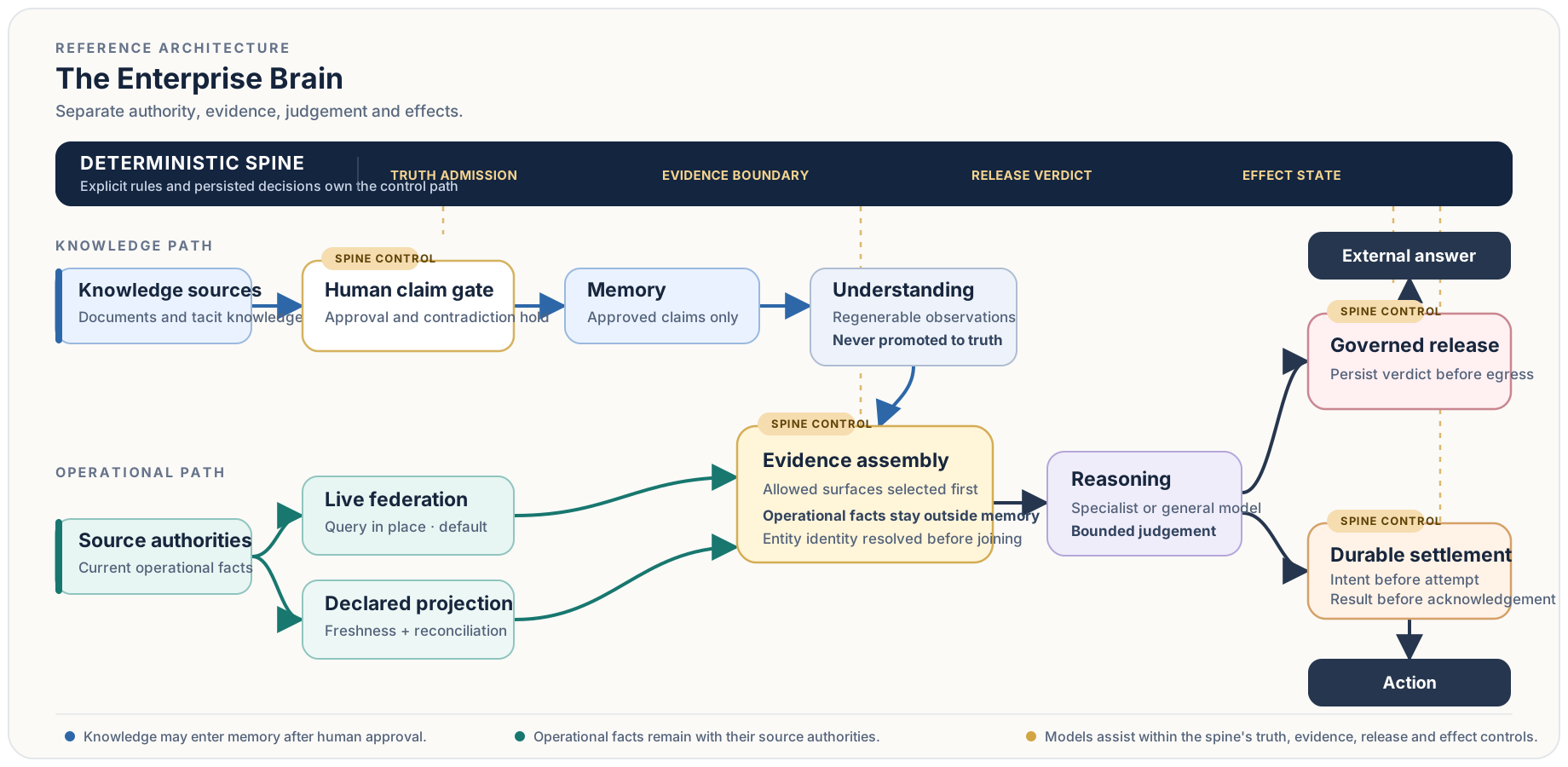
Knowledge claims reach memory only through governed admission. Operational facts reach evidence assembly through live federation by default, while an explicitly governed operational-derived view may also supply evidence when materialisation is declared. Both operational routes remain outside memory and recall.
The spine is the control structure beneath memory, understanding, reasoning and action. Each stage can use a model, but its governing decisions remain inspectable and replayable without asking a model to remember what happened.
Keep each kind of truth in its proper place
An enterprise already has authoritative systems. Finance, customer, risk and operational platforms own facts within their respective domains. A brain that copies all of those facts into a knowledge store creates a second authority and an immediate reconciliation problem.
The design separates authority from two subordinate structures: derived views and runtime control.
| Information class | What it contains | Governing rule |
|---|---|---|
| Knowledge source of truth | Approved semantic claims that the organisation may act on as true | No claim enters without human approval; contradictions are held |
| Operational source authority | Current facts owned by an operational system | Reached through governed live federation by default |
| Knowledge-derived view | Rebuildable indexes, clusters, summaries and observations from approved knowledge | May be recomputed; never promoted to truth by computation |
| Operational-derived view | Rebuildable projections from operational sources | Carries a build stamp and freshness limit; undergoes independent reconciliation |
| Governed control state | Workflow events, review decisions, lineage stamps, release records and serving condition | Controls operation without becoming semantic truth |
The knowledge source of truth is often labelled L0. It contains claims such as an approved policy interpretation, a named decision, a confirmed definition or an accepted term. Operational facts do not pass through that claim gate because their owning systems remain authoritative.
Derived views are useful because source truth is rarely arranged for the question being asked. Their defining property is disposability. The system can rebuild them from an authority, and their loss never changes what the organisation has approved as true.
Governed control state belongs beside those planes. A review decision or release refusal is authoritative for system operation, yet it says nothing about the truth of a business claim. Keeping control state separate prevents workflow history from leaking into institutional memory.
Admit knowledge through a human claim gate
Knowledge enters as a candidate claim with its source, provenance, protection class and effective period. Human capture follows the same route: a person proposes tacit knowledge and confirms the recorded claim before admission.
The claim gate checks the proposal against approved knowledge. A compatible claim can proceed to human approval. A contradiction is held with both positions visible, even when the model expresses high confidence. Resolution records who decided, when, what evidence they considered and why the selected claim governs.
Maker-checker means that a proposal or change made by one person is independently reviewed by another. Maker-checker control and data provenance predate generative AI. The architecture applies those established disciplines inside the memory boundary. No semantic claim reaches L0 on a model’s authority, and no later summary can silently change the approved record.
Separate recall from observations
Recall returns approved claims and their provenance. It answers questions about the decisions and definitions the organisation has approved as knowledge.
An observation is an interpretation supported by evidence and derived from that knowledge. Deterministic analysis finds a cluster or recurring relationship across cited evidence, while constrained narration explains it.
Recall remembers; observations understand. An observation remains a regenerable map of the territory. It never becomes the territory itself.
A new observation becomes active only after its gates pass. A detected contradiction moves it to held; dissolution of its underlying cluster retires it. Evidence or identity changes trigger regeneration and fresh gates.
Held and retired observations do not serve or embed. Observations are regenerated, never edited by hand, so the route from source claims to interpretation stays inspectable.
Federate operational facts at the point of need
Questions often combine institutional knowledge with current operational facts. The brain reaches operational authorities through governed connectors.
Every source stream has an explicit information plane, meaning its declared route into the architecture. Operational facts use operational federation. Sources offered as organisational knowledge use knowledge ingestion, while tacit knowledge proposed by a person uses human capture.
That routing choice is separate from the five information classes above, which describe what the system stores or derives. No stream receives a default, and a connector may expose several streams across different information planes.
Live federation is the default. Federation queries an authoritative source in place through a governed connector. A request for a current balance, position, case state or exposure therefore goes to the system that owns that fact.
The result may contribute to an answer, but it is structurally excluded from recall and never becomes L0 knowledge.
Some operational workloads need a mastered or consolidated analytical projection. An explicit materialisation dial permits that choice. Every projection carries a build stamp and freshness limit, undergoes independent reconciliation, refuses service when stale and remains outside the recall path.
Entity mastering happens at enterprise scope before evidence is assembled. Deterministic rules resolve clear equivalences among records for the same customer, instrument, supplier or other entity. Confirmed equivalences contribute to one enterprise entity master.
Only uncertain matches are proposed for maker-checker review, and they never merge automatically. The master consumes separately recorded lineage and survivorship decisions for each field, which determine the value that prevails without losing its source.
Route the evidence before choosing the reasoner
Intent routing selects the governed evidence surface able to answer a request. A policy question may route to approved knowledge, while a current exposure question routes to an operational authority. A pattern question can use an observation, and a compound request may assemble evidence from several planes.
Reasoning routing happens after evidence assembly. It chooses a suitable specialist or general reasoner within the authority allowed for the request. Both decisions are recorded as structural choices, with deterministic guards around the allowed routes.
A later audit or replay uses those recorded decisions because rerunning a router that uses a model may choose differently.
Routing evidence first stops the reasoner from choosing its own evidence boundary. The trace records the consulted surfaces and route used to assemble evidence, with the structural routing claim and its reason. The reasoning policy applied is recorded beside them.
Make release a governed event
Permission to retrieve a source does not imply permission to release an answer. The final response may combine facts in a way that raises its protection level or reveals information that no single source exposed.
An external answer surface is any destination outside the governed reasoning boundary, including a user interface, API, report or outbound agent. Every registered surface uses one atomic governed release path.
Protection classification states how sensitive the assembled answer is. The named subject and access grant identify its intended recipient. Lawful basis records why processing is permitted, while minimisation limits the response to information needed for that purpose.
The spine also tests the query policy and obtains any oversight verdict required for release.
The release or refusal record is persisted before any byte leaves the boundary. An unknown surface defaults to protected and is denied. A later audit reconstructs the decision from that authoritative record and any evidence references still permitted.
The exact payload remains available only while access and retention policy allow. Expiry or erasure leaves a tombstone containing no identifying data. No replay, recovery, projection or export may rehydrate the payload.
Make agent work durable before it has effects
Work that may run for a long time needs more than a chat transcript. A durable workflow log records intents and results, then carries governed references to assembled evidence, approvals, release decisions and effect settlement. Erasable payloads stay under their own retention policies and are never copied into the journal.
An effect’s idempotency class records whether repeating it is safe. The workflow persists intent before an external effect begins and persists the result before any caller sees it. If execution stops between those points, it resumes from recorded state.
The recovery policy uses the idempotency class to decide whether retry is safe or inspection and reconciliation are required. It can also require a human decision before retry.
Replay does not ask a model to recreate an earlier output, and it cannot pretend to reverse an external effect. Irreversible recovery crosses a human gate. Approval waits are durable workflow state and therefore survive restarts.
Learn the organisation through governed discovery
The brain needs a disciplined route from unfamiliar sources to usable organisational knowledge. Discovery starts with sources ranked by materiality and sensitivity. It rejects any source stream whose information plane is missing.
The learn-and-run arc then establishes enterprise entity identity and queryable lineage, which records the route from source to reported figure. A person writes the data product contract for each operational product or projection. The contract specifies how the product is generated and served safely, covering grain, source entities, figures and its survivorship and freshness posture.
The generation pipeline builds from that contract and refuses service when live conformance checks fail. A change in the source invalidates the affected projection at once; service resumes only after rebuild and independent reconciliation.
Wider organisational contracts govern source boundaries and service relationships, along with other operating obligations. For example, a service contract names the owner of a business outcome and the result it must provide. It also identifies the consumer permitted to rely on that result.
An organisational contract may begin as a draft that states the intended arrangement, or it may be observed by triangulating independent evidence of a stable operating pattern. Maker-checker review can promote either version to govern.
Promotion does not create another truth gate: semantic claims inside the contract still pass through claim admission, and consequential operation waits for its durably recorded oversight verdict.
Repair in bounded steps
Self-healing starts with deterministic detection. The system identifies a failed dependency, stale projection, broken contract or degraded evidence path, then chooses a bounded response from declared repair policies.
Repair follows dependency order and keeps degradation visible. Reversible recovery can run automatically within its authority. An irreversible step waits for a person, while exhausted repair ends in a loud terminal condition with the evidence needed for intervention.
Observability completes the loop. It records detection, degradation, attempted recovery and the resulting condition. The system never converts repeated failure into an apparently successful answer.
Draw topology from trust boundaries
Business units inside one enterprise are soft scopes. They contribute to one enterprise entity master while retaining policy scopes for access, stewardship, lineage and local meaning.
A declared hard boundary changes the physical topology. A sensitive domain with separate trust requirements receives its own knowledge store and index without creating another enterprise master. If the master spans that boundary, it consumes only a governed projection.
Across enterprises, storage is physically separate, and only governed knowledge or insight projections may cross the boundary.
Basing topology on declared trust boundaries prevents organisational charts from deciding data isolation by accident. Trust, sensitivity, legal separation and contractual obligations determine the boundary; reporting structure determines a softer scope within it.
Keep the logical architecture independent of the solution
The logical reference architecture defines capabilities and contracts, plus their invariants and trust boundaries. Claims need governed admission, while operational projections require freshness and reconciliation. Releases need a persisted verdict, and effects need durable settlement. Those obligations do not name a product or deployment model.
A solution architecture is an adopter’s illustrative mapping of those obligations to components. One pattern may contain source adapters, a claim store and index, pipelines for derived views, a policy enforcement point, a workflow engine, effect adapters and an observability plane.
Each component remains replaceable while the logical contracts hold. An adopter can centralise some functions and distribute others across existing platforms. The trust boundaries and invariants survive those choices.
The reusable reference artefacts are published under CC BY 4.0 in the Enterprise Brain Reference Architecture repository.
The useful boundary
The Enterprise Brain joins memory, understanding, reasoning and action without giving the model ownership of truth. Its deterministic spine governs what enters memory, which evidence answers a request, what leaves the boundary and how effects settle.
Keeping those controls outside the model allows models to improve without forcing the organisation to redefine its rules for truth and authority or its access and approval controls each time.